

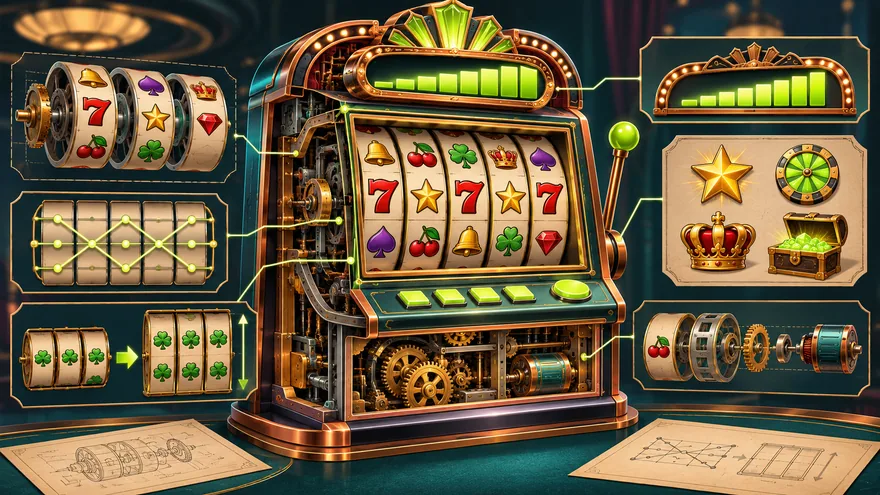
A simple model
If a game’s published RTP is 96%, the model’s long-run expected return is NZ$96 for each NZ$100 staked across the enormous sample used by the maths—not necessarily by one person. The corresponding theoretical house edge is 4%.
house edge = 100% − RTP
With repeated play, “amount staked” counts every recycled bet. Depositing NZ$100 and making 200 bets of NZ$1 creates NZ$200 of turnover even if some returned credits were reused.
RTP is not hit rate
A hit rate describes how often a spin produces a return under the game’s definition. A game can produce frequent small returns, including returns below the stake, while maintaining the same RTP as a game with fewer larger returns. Sounds and animations may label a sub-stake return as a win-like event; financially it is still a net loss for that spin.
RTP is not volatility
Two games can both publish 96% RTP. One may distribute more small returns; the other may place more of the theoretical return in rare features or large prizes. That distribution difference is volatility. Read volatility explained.
Different configurations
The same game title can be supplied in more than one RTP configuration. Do not copy a number from a review or another casino. Open the help/paytable for the exact live version and record the configured RTP and date. If the value is not disclosed, write “not verified”, not an industry default.
A hypothetical calculation
Suppose a model has 96% RTP and NZ$500 of total turnover. The theoretical long-run return associated with that turnover is NZ$480 and theoretical house edge is NZ$20. This is an expectation, not a boundary. A short session can finish far above or below it.
What NZ sources say
Safer Gambling Aotearoa describes RTP as the percentage a game pays back over time and stresses that it is based on millions of bets or spins and does not predict short-term results. Its pokies guidance also explains that outcomes are random and past spins do not make a win due.
Checklist
- exact game/provider/version;
- live help-file RTP;
- whether bonus/features are included;
- configured bet and rules;
- checked date;
- no conversion of RTP into a personal win probability.
FAQ
Is 96% RTP good?
It implies a 4% theoretical house edge under the model. It still predicts an expected loss over time and does not make a game profitable.
Does RTP reset?
RTP is a property of the model/configuration, not a meter that must return a target amount to a particular player.
Can a game be due to pay because it has lost recently?
No. Independent random outcomes are not corrected for an individual session.
Is demo RTP always the same?
Do not assume it. Compare the published rules/configuration of demo and real-money versions.