

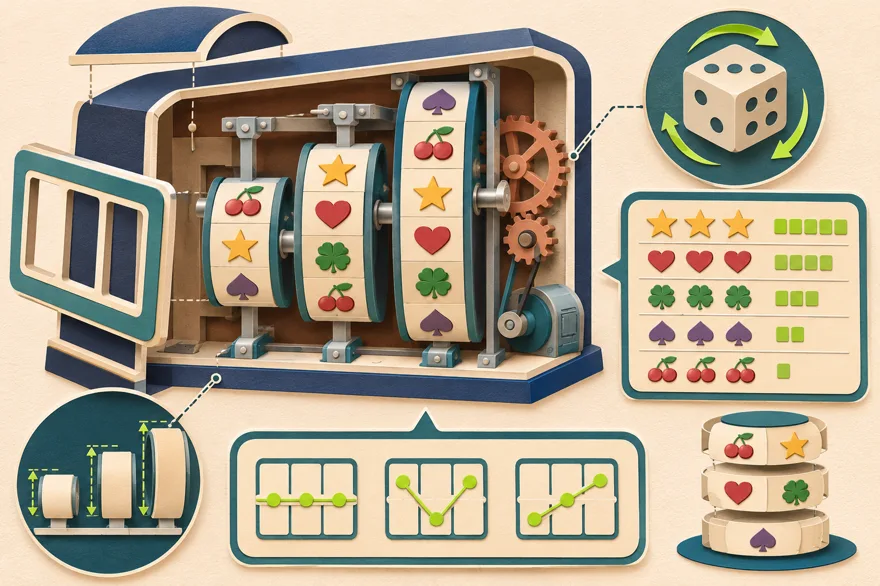
Start with the right question
| Reader task | Guide |
|---|---|
| Understand long-run return | RTP explained |
| Compare smooth versus swingy result patterns | Volatility explained |
| Decode changing reel heights and ways | Megaways |
| Understand symbol collection/respin features | Hold and win |
| Learn wheel bets and settlement | Roulette rules |
| Learn hit, stand, double and split | Blackjack rules |
| Learn Player, Banker and Tie outcomes | Baccarat rules |
| Use free mode for interface learning | Demo mode |

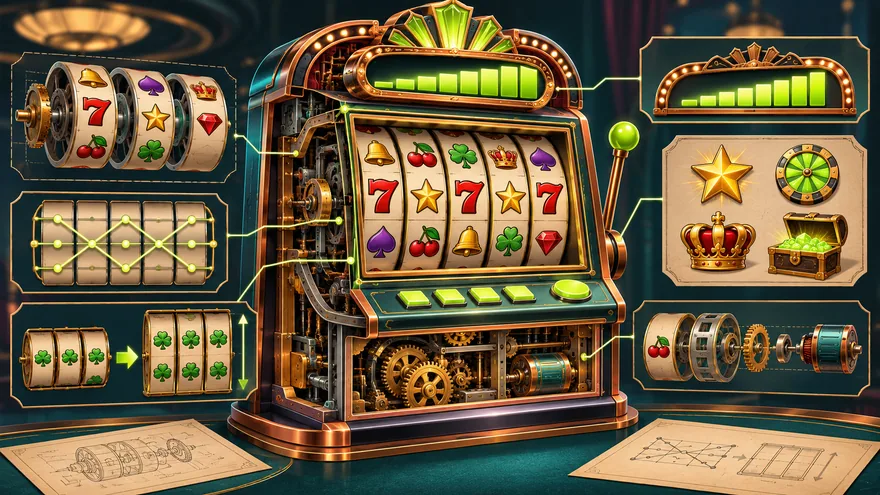
Four facts to capture from a pokie help file
- Configured RTP. This is a long-run mathematical percentage, not a forecast for a session. The same title may have more than one configuration; the live help file controls.
- Winning system. Fixed paylines, adjacent reels, cluster pays or “ways” are not interchangeable.
- Bet scale. The displayed total bet, coin value and lines/ways can change together.
- Feature rules. Trigger symbols, reset rules, caps, modifiers and feature contributions must be read for that release/version.
Safer Gambling Aotearoa explains that pokie outcomes are random, false patterns do not predict the next result and game design can celebrate returns that are smaller than the stake. Treat an animation as feedback, not evidence that the game is warming up.
Online and land-based rules
The DIA publishes consolidated rules for table games authorised in New Zealand land casinos. They are a reliable reference for established structures, but an online table may use a different variant, number of decks, dealer procedure or side bet. This site identifies the base comparison points; the specific game’s live rules always control.
No “winning systems”
Changing stake after a loss, choosing a machine because it has not paid recently, or reading a near miss as progress does not change an independent random outcome. RTP describes a model over many bets. Volatility describes distribution, not timing. Demo results do not predict real-money results.
A neutral game card should show
- exact title/provider/version if a specific release is discussed;
- rules or paytable source and checked date;
- RTP configuration shown in that source;
- winning pattern and feature mechanics;
- minimum/maximum bet as displayed, if verified;
- whether demo mode uses the same published rules;
- a risk note and link to responsible gambling.
It should not show invented “hot” status, probability-free star ratings, max-win marketing as an expected result or claims that a mechanic pays better without comparable source data.
FAQ
Is RTP the chance of winning a spin?
No. RTP is a long-run return percentage across the game model. It is not the hit rate and does not predict an individual spin or session.
Does high volatility mean higher RTP?
No. Volatility and RTP describe different properties. A high-volatility game can have the same RTP as a low-volatility game but distribute returns differently.
Are online roulette rules identical to a NZ casino floor?
Not necessarily. Compare wheel type, bet rules, settlement and special rules in the specific table.
Can demo mode prove a game is fair?
No. It helps learn controls and rules. Fairness requires appropriate regulation, testing and a verifiable live version—not a short demo session.