


This guide does not recommend an operator or a way around a restriction. Availability must be checked in the live cashier and current terms. During New Zealand’s 2026–27 regulatory transition, an old operator list can become legally and practically obsolete quickly.
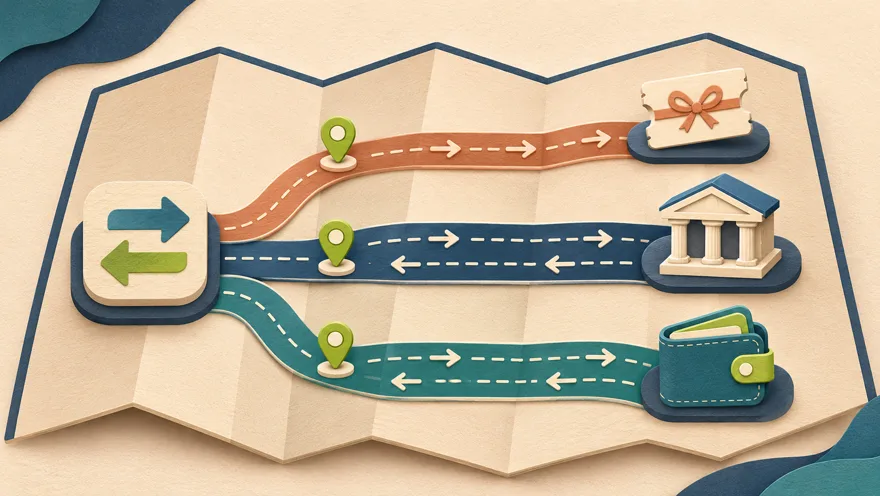
Method map
| Method family | Deposit | Withdrawal | Main checks | Cost questions |
|---|---|---|---|---|
| NZ bank transfer | Often possible where listed | Often possible to an account in the same name | Domestic or international route, reference, cut-off/review time | Operator fee, intermediary fee, receiving fee, FX |
| Visa/Mastercard debit | Commonly shown, but acceptance varies | Not guaranteed; card push payments depend on operator/issuer | Debit not credit, online/international setting, merchant restriction, name match | Foreign transaction and FX margin |
| E-wallet | Only where the operator and wallet permit gambling for the account/jurisdiction | Often a separate route after operator approval | Wallet currency, verification, account name, wallet-to-bank leg | Casino-to-wallet plus wallet conversion/withdrawal fees |
| Prepaid voucher | Usually deposit-only | Usually no return path to the original voucher | Voucher currency, maximum balance, ownership/receipt | Retail load fee, unused balance, FX |
| Bank redirect such as POLi | Historically deposit-oriented where supported | No general direct withdrawal function | Current NZ support, bank compatibility, merchant acceptance | Any bank/processor charge and alternative payout verification |
| Mobile wallet | Usually represents an underlying card | Not necessarily available as a payout label | Underlying card, tokenised transaction, return route | Card issuer FX/foreign transaction fee |
| Cryptocurrency | Operator-specific and high-risk | Operator-specific | Network/asset/address, volatility, irreversible transfer, legal/AML checks | Network, exchange, spread, tax consequences where applicable |
The table describes method characteristics, not current acceptance by any casino. A method’s presence at checkout does not prove the service is licensed, safe or available to New Zealand customers.
Ask these seven questions before a first deposit
- Is the operator currently entitled to serve people in New Zealand? The DIA transition changes on 1 December 2026 and again as licences are issued in 2027.
- Is the account balance held in NZD? A site that displays an NZ$ deposit button may still keep the gambling balance or settle withdrawals in another currency.
- Can the same method receive a withdrawal? If not, what method in your own name must be registered and verified?
- When does the quoted clock start? At request, after review, after approval or after dispatch?
- Which party charges each fee? “No casino fee” says nothing about issuer, intermediary, wallet or exchange costs.
- What are the minimum and maximum amounts in both directions? A low deposit minimum can sit beside a higher withdrawal minimum.
- What verification can be requested? Identify the secure upload route before sending money.
Deposit route and withdrawal route are different decisions
When a deposit succeeds, the operator receives a payment confirmation. When a withdrawal is requested, the operator has to check the account, determine a permitted return route and send funds to a verified destination. A voucher cannot usually be reloaded. A bank redirect is an instruction from your account, not a reusable destination. A tokenised mobile-wallet payment may map back to a card, but that does not make “Apple Pay” or “Google Pay” a withdrawal option.
New Zealand’s 2026 Regulations anticipate that the registered withdrawal method may differ from the registered deposit method where returning to the deposit method is not possible. They also require only one registered deposit method at a time in the licensed regime. That future rule makes the route-planning question more—not less—important.
NZD and foreign-currency exposure
There can be three currencies: the currency you authorise, the currency the operator’s account uses, and the currency the payout rail settles. A wallet with a non-NZD balance may convert on deposit and again on withdrawal. A card issuer may convert a foreign transaction even if the cashier showed an NZD estimate. Keep the original confirmation, exchange rate and final statement before calculating the effective cost.
Worked example, not a market quote: if NZ$100 is converted at a 2.5% margin on the way in, the gambling balance begins with the equivalent of NZ$97.50. If the remaining balance is converted again on the way out, a second margin applies to that later amount. The exact result depends on the rate base and fee method.
Read NZD and currency conversion for a reproducible calculation.
Timing: do not combine unlike clocks
Domestic interbank payments among participating New Zealand banks are processed every day of the year. An offshore payout may still involve:
- an operator pending period;
- identity or method-ownership review;
- a processor in another time zone;
- an international or correspondent route;
- bank fraud/compliance review;
- a separate wallet-to-bank transfer.
Therefore “same-day bank payments in NZ” cannot be used as evidence that an online-casino withdrawal should be same-day end to end.
Method-by-method reading
Bank transfer
Best when you want a documented bank destination and can obtain a transfer reference. Confirm whether “bank transfer” means a domestic NZ payment, an international wire or a local collection account. See bank transfers.
Debit cards
Confirm that the card draws on your own funds. Credit contracts are prohibited in the future licensed framework. A decline can arise from the issuer, processor or account restriction. See debit cards and deposit declined.
E-wallets
The wallet adds an account, verification process, currency and second withdrawal leg. It can be fast after operator release without making the operator stage faster. See e-wallets.
Prepaid vouchers
Treat a voucher as a one-way deposit unless current terms explicitly show a return path. Before purchase, identify the withdrawal method and its verification requirements. See prepaid vouchers.
POLi
POLi has historically been a deposit instruction rather than a withdrawal rail. Current support and bank acceptance vary, and search results make contradictory claims. See the POLi evidence page rather than relying on an operator badge.
What not to infer from a cashier logo
- It does not prove the method works for your country, currency or account.
- It does not prove a payout can return by the same label.
- It does not prove there is no fee.
- It does not prove the operator is licensed for New Zealand.
- It does not prove the payment provider endorses the operator.
- It does not cancel identity, age, source-of-funds or safer-gambling checks.
Frequently asked questions
Which payment method is best for NZ players?
There is no universal best. Choose the route with a verified withdrawal destination in your own name, understandable total cost, acceptable time and current legal availability. Do not optimise only for deposit speed.
Can a casino make me withdraw another way?
Payment-network limitations and anti-fraud rules can make return to the original method impossible. Ask for the written reason and the permitted alternative. The alternative should belong to you and may require verification.
Are credit cards allowed?
New Zealand’s 2026 Regulations prohibit payment methods involving a credit contract for licensed online casino gambling. The transition and operator status matter; treat any credit-funded option as a regulatory and harm-risk warning, not a benefit.
Does a weekend delay mean the bank is closed?
Not necessarily. NZ domestic payment processing operates seven days a week, but an operator or international processor may work to different schedules.
Should I try another method after a decline?
First identify why the payment was declined. A deliberate gambling block or account safety control should not be bypassed. Repeated attempts can also complicate the evidence trail.