

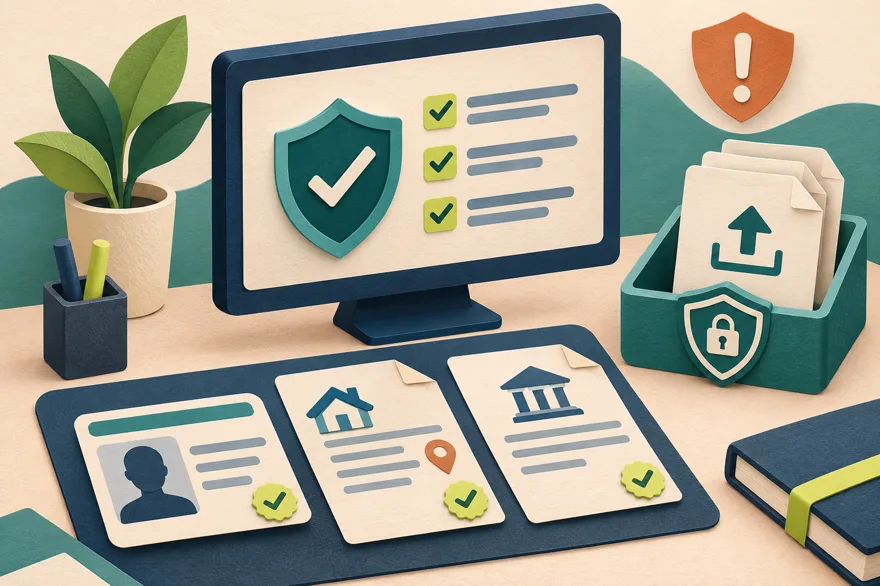
Requirement map
| Fact | Typical evidence category | Check before sending |
|---|---|---|
| Identity and age | Government photo ID | Accepted type, validity, all corners/readability |
| Residential address | Recent official statement or bill | Age of document and exact address match |
| Bank account ownership | Bank document showing name and account number | Whether unrelated transactions may be redacted |
| Card ownership | Masked card/account evidence | Required visible digits; never expose security code |
| Wallet ownership | Wallet account statement/profile | Legal name, account identifier and currency |
| Source of funds | Income/savings/transaction records appropriate to request | Scope, period, legal basis, privacy and retention |
This is a category guide, not a request to send documents to this site.

New Zealand licensed framework
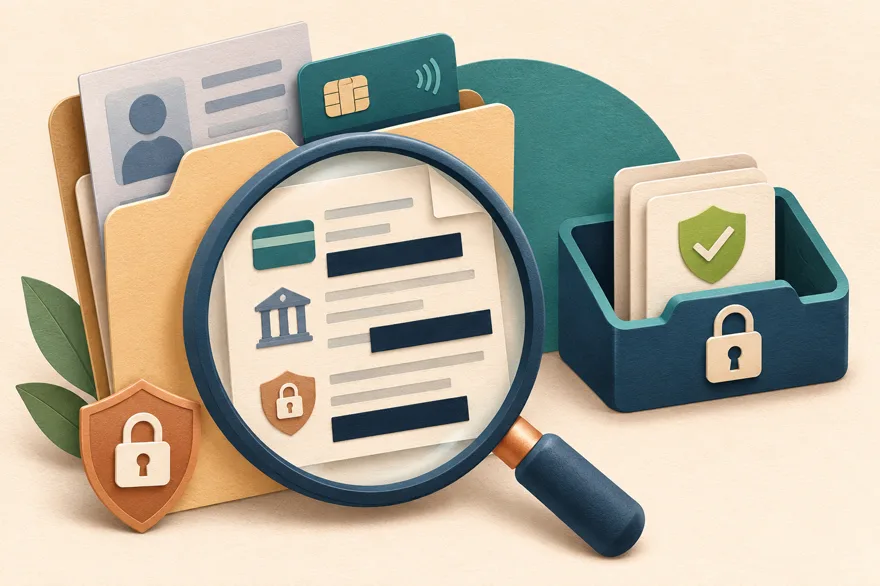
The Online Casino Gambling Regulations 2026 require a licensed operator to collect specified account information and verify identity and that the customer is at least 18 before account access. The transition means not every current offshore process follows the future NZ sequence. An operator’s status and governing licence still matter.
Safe document workflow
- Navigate to the operator independently; do not use an unsolicited message link.
- Confirm the authenticated account and secure upload route.
- Read the privacy notice: controller, purpose, retention and support contact.
- Ask which fact and time period must be proved.
- Use a genuine, current, legible document.
- Redact only what the official instructions permit; never alter names, dates, amounts or ownership fields.
- Save the upload receipt and case number.
- Record the promised review time and outcome.
- Remove unnecessary local copies from shared devices and cloud links.
Never email a password, security code, full card number or login credentials. Do not post documents to social media or public forums.
Build a submission checklist from the actual request before opening your camera or scanner. For each document, record the purpose stated by the provider, the required visible fields, the accepted format and the authenticated upload location. If the request is ambiguous, ask for clarification once in writing. Sending several unrelated documents can expose more information while still failing to meet the particular check.
Use a readable copy that shows the requested details and preserves the document's genuine content. Do not edit dates, names or balances to make an account appear consistent. Ask whether masking unrelated transactions or watermarking a copy is permitted before doing so; an altered file may be rejected even when the privacy motive is reasonable. Keep a private record of the submitted file and the submission confirmation. If another team repeats the request, refer it to the existing case and ask whether the earlier evidence was received, rejected or inaccessible, rather than automatically sending a larger collection.
Name and address mismatches
Small formatting differences, a recent move, married name, joint account or abbreviated address can trigger a query. Correct the account through the official process and provide lawful supporting evidence. Do not create or edit a document to make it match.
A mismatch needs a factual explanation, not a cosmetic account edit. Compare the account profile, identity document and payment record field by field. Note whether the difference concerns a legal name change, abbreviated middle name, outdated address or a payment account belonging to someone else. These are different situations and should not be described simply as a typo. Ask the provider which record must be corrected and which evidence supports that correction.
Do not create a second account to obtain a cleaner-looking set of details. Preserve the original profile and correspondence so the correction has a clear history. If you have moved, ask whether a current address document is sufficient and whether the old address remains relevant to a past transaction. If the payment method is not in your name, disclose that directly instead of trying to alter its proof. Until the provider confirms the accepted correction and the payment route, avoid adding more deposits that would create further ownership questions.
Source-of-funds requests
Ask for the reason, scope, accepted documents and secure route. A legitimate review should be tied to compliance or risk requirements, not to an unexplained demand for more money. This site will not advise how to evade checks.
When the request becomes concerning
- documents are requested through a personal messaging account;
- the requested data is unrelated and support cannot explain why;
- a payment or fee is demanded to “verify” the account;
- the document list changes repeatedly without explanation;
- no privacy/retention information is available;
- support asks for full credentials or remote access to your device.
Stop, preserve evidence and use the formal complaint/licensing route.
FAQ
Can I withdraw without verification?
Do not assume so. Licensed operators must verify identity/age, and payment ownership checks can be required. Claims of “no KYC” can indicate reduced protection rather than a benefit.
Why do I need to prove a bank account I did not deposit from?
If the original method cannot receive withdrawals, the alternative destination may need ownership verification. Ask for the written basis.
Can I cover transactions on a bank statement?
Only if the official instructions permit redaction. The operator may need specific transactions or source information. Never edit required facts.
How long does verification take?
There is no universal time. Record the published review period and ask what remains outstanding. If the time passes, use the pending-withdrawal workflow.